Highlights

I am broadly interested in the evolution and final fate of interacting binary stars. I study how stellar interactions reshape their orbits and what the resulting systems look like by the time we observe them through electromagnetic and gravitational radiation. My current research focuses on mass transfer in eccentric orbits a regime long treated as a special case, but which turns out to be more common than previously thought. I study how mass flows between the binary components, how, in some cases, it escapes the system, how these exchanges alter the orbital evolution, and how they ultimately determine the final fate of these systems. I make theoretical predictions that can be compared with real binaries, from post-mass-transfer systems observed by Gaia to gravitational-wave sources detected by the LVK and, in the future, by LISA. My goal is to understand how binary interactions reshape the lives of stars and ultimately determine their deaths.

Selected publications

Reframing the wide eccentric binary problem: Eccentricity as a probe of mass-transfer physics
Parkosidis A., Toonen S., Laplace E., Schaffenroth V.

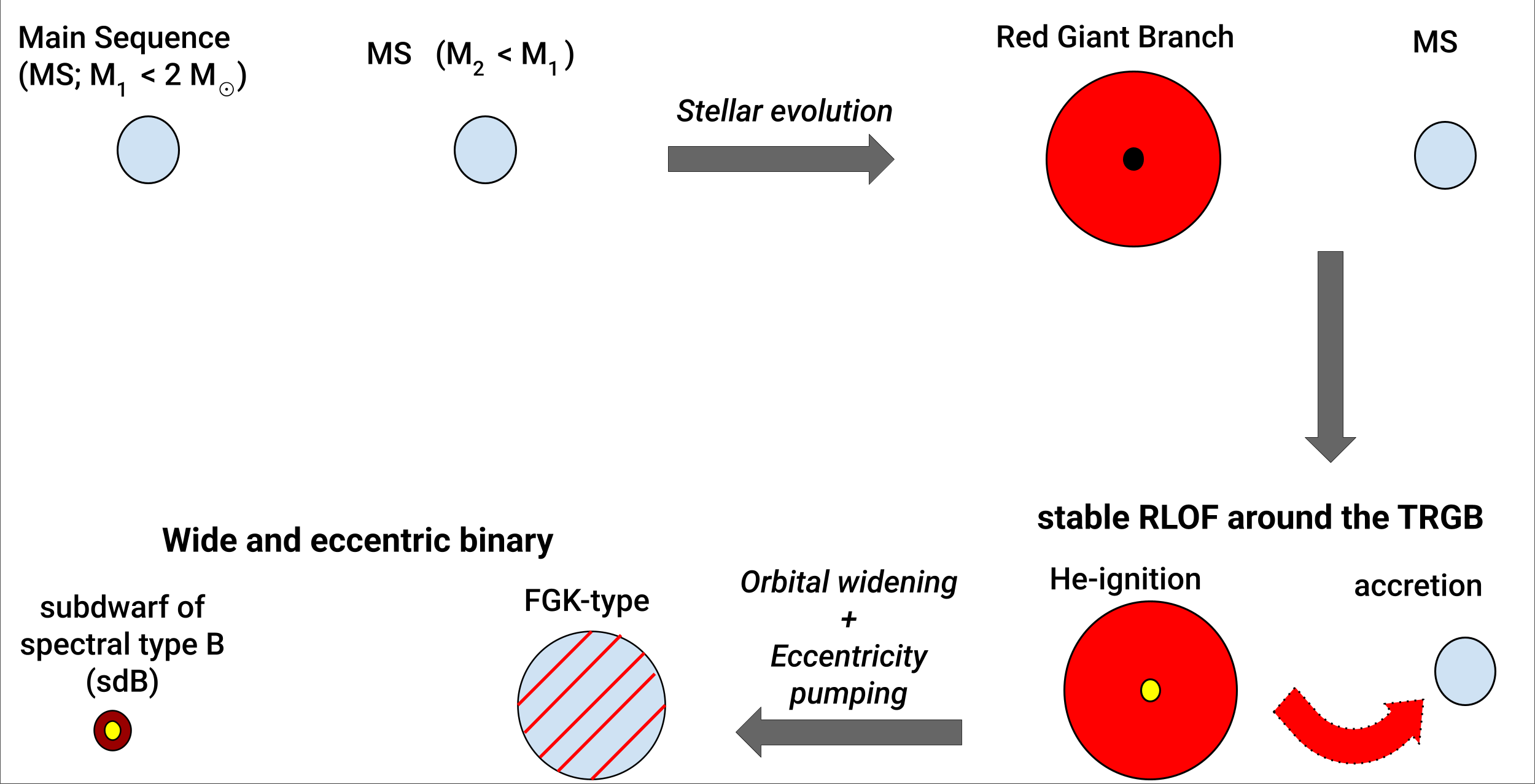
The orbital evolution and final fate of interacting binaries are strongly influenced by mass transfer (MT). Classical binary-evolution theory generally assumes circular orbits during MT, yet nonzero eccentricities are commonly observed in wide post-interaction binaries, and their origin remains unclear. Eccentric MT offers a promising solution.

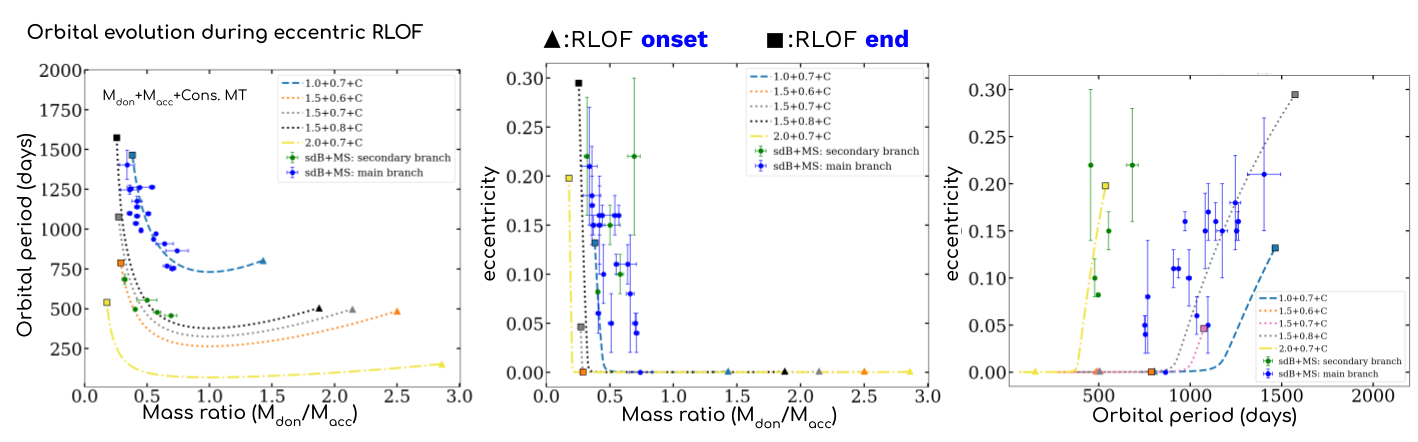
In this work, we confront the general mass-transfer (GeMT) model, the first complete framework for MT at arbitrary eccentricity, with observations of wide sdB+MS binaries. We isolate the effects of eccentric MT and show that it naturally reproduces their observed orbital-parameter distributions and correlations. We further demonstrate that generally post-MT eccentricity depends directly on key MT properties, including transferred mass, accretion efficiency, and angular-momentum loss. Given the multitude of eccentric post-MT binaries with components ranging from low- to high-mass stars to compact objects, we propose that post-MT eccentricities offer a new window onto binary evolution, presenting a powerful tool to constrain highly uncertain binary-evolution parameters and mass-transfer formation histories across diverse populations. Post-MT eccentricity should therefore be embraced as a key observable, rather than treated as a problem to be corrected.

All publications →

Selected talks

Eccentricity as a Probe of Mass-transfer Physics

| Institute of Astronomy, KU Leuven, Belgium | Colloquium

Binary star systems are common: at least half of solar-type stars and nearly all massive stars reside in binaries. Binary interactions such as mass transfer, tides, common-envelope phases, and mergers profoundly alter stellar evolution, producing various phenomena that single-star evolution cannot explain. Examples range from chemically peculiar stars and blue stragglers to supernovae, gamma-ray bursts, and gravitational-wave mergers. More recently, large surveys, such as Gaia and TESS, have revolutionized our census of binaries across the Galaxy, revealing that eccentricity in wide, evolved post-interaction systems is far more common than previously thought. This suggests a fundamental link between binary interactions and orbital eccentricity, yet the theoretical origin remains poorly understood and synthetic models still struggle to reproduce the observed orbital properties.

In this colloquium, I discuss our evolving understanding of eccentricity in the context of interacting binaries, review different eccentricity-pumping mechanisms and present the General Mass Transfer (GeMT) model, a new semianalytic framework for the secular orbital evolution of mass-transferring (MT) binaries. By comparing predictions to observations, I demonstrate that nonzero eccentricity is a natural outcome of MT and depends directly on key MT parameters. Given the multitude of eccentric post-MT binaries with components ranging from low- to high-mass stars to compact objects, I show that post-MT eccentricities offer a new window onto binary evolution, presenting a powerful tool to constrain uncertain MT parameters and formation histories across diverse populations

All talks →